

Trump Keeps 2028 Republican Primary Field Open
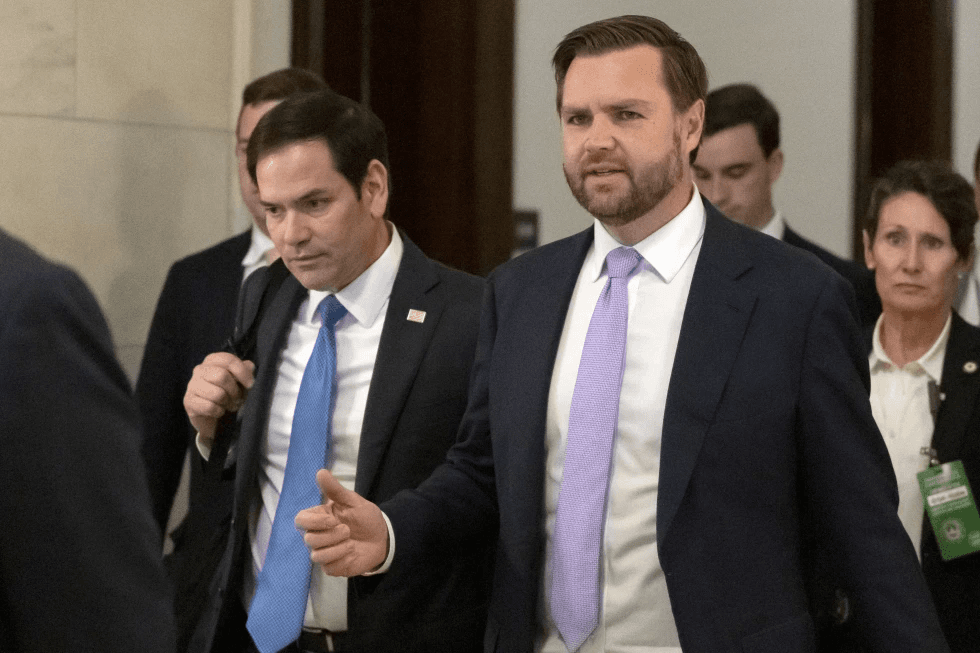
In an interview on Wednesday, President Trump said that a 2028 presidential ticket including JD Vance and/or Marco Rubio would be hard to beat, but he left the door open for other candidates and would not commit to an endorsement. The comment signals that although Vance is widely viewed as the favorite, Trump is keeping the field open.
In 2028 Republican primary polling, Vance leads by a wide margin of 30.3 points, with 45%, followed by Donald Trump Jr. at 14.7%, Marco Rubio at 9.3%, and Ron DeSantis at 8.3%. These numbers should be taken with a grain of salt, however, as early primary polls are more a test of favorability and name recognition than likely voter preferences during primaries that are still two years away.
While some combination of Rubio and Vance would likely be the early favorite, other rumored contenders outside the administration are also likely to enter the race.
The field is likely to include Republicans who take a more hawkish approach to foreign policy and Iran, such as Sen. Ted Cruz, who has spent the past year sparring with Tucker Carlson over those issues. According to the Washington Post, Cruz’s friend Morton Klein said that Cruz seemed to be “seriously” considering a 2028 run. Others, including Nikki Haley, could fill a similar role, as she did during the 2024 Republican primary.
Virginia Gov. Glenn Youngkin and Ron DeSantis could also have viable paths, running on a platform similar to DeSantis’ 2024 campaign: MAGA-aligned, but with a more reserved tone. While that approach proved unsuccessful when Trump was on the ballot, it may prove more effective with Republicans in power but facing public dissatisfaction.
Another faction likely to have representation is the isolationist or paleo-conservative wing of the party, including media figures such as Steve Bannon and Tucker Carlson. Both have been highly vocal throughout Trump’s second term, arguing against the use of military force in Iran and the broader Middle East, and opposing the emerging pro-tech faction on the right, particularly on issues like H-1B immigration. In December, former Rep. Matt Gaetz said in an interview with Carlson that Bannon “is going to run for president on a straight Elizabeth Warren wealth tax economic agenda.”
Growing disillusionment with the Trump administration also creates an opportunity for a dark horse to enter the race. One such candidate could be Marjorie Taylor Greene, a Trump loyalist turned vocal Trump critic over his efforts to slow-walk the Epstein files. Another could be John McEntee, the former Trump aide turned TikTok star. During the 2024 election cycle, McEntee was a senior advisor to the infamous Project 2025 while simultaneously having the most viewed political account on TikTok.
Each of these candidates have the opportunity to attract Republican primary voters that Trump lost during his first year in office. According to a January New York Times poll, young voters ages 18-29 saw a dramatic shift over the first year, moving from -8 net support at the time of the election to around -42 net support one year later. In Economist/YouGov polling, Trump’s approval fell from 47% to 33% among moderates and from 93% to 80% among 2024 Trump voters. This leaves a sizable portion of independents, young people, and Republicans available for an outside candidate to attract.
On the Democratic side, there is even more variability.
Former Vice President Kamala Harris leads the RCP Polling Average for the Democratic primary by a small margin with 29%, followed by California Gov. Gavin Newsom at 23.2%, former Transportation Secretary Pete Buttigieg at 9.5% and Rep. Alexandria Ocasio-Cortez at 8.6%.
Similarly, within the Democratic Party, a little-known candidate could rise quickly through the ranks, as seen in the New York mayoral race. On May 25, one month before the New York City Democratic primary, now-Mayor Zohran Mamdani had just a 4.5% chance of winning in the Polymarket odds. After he won the primary, his odds surged to 75%.
While such a dramatic shift is less likely to occur as quickly in a presidential primary, with roughly two years until primary voting begins, an unknown or currently overlooked candidate could still mount a viable run in either party.
State of Union
.