

States Redraw Maps Despite Unpopularity of Gerrymandering
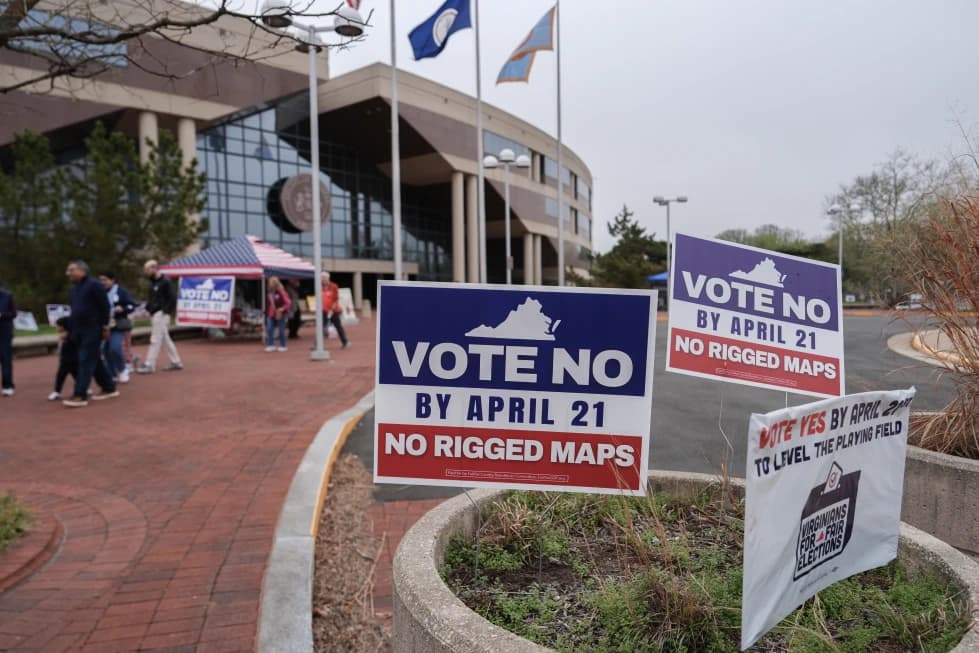
Over the last year, red and blue states alike have passed laws to gerrymander their congressional maps more favorably for their respective parties. Despite the practice becoming commonplace over the last year, polling indicates that gerrymandering is extremely unpopular.
The latest Economist/YouGov poll, conducted April 24-27 among 1,836 U.S. citizens, found that only 7% said states should be allowed to draw congressional districts in a way that intentionally favors one party over the other. An overwhelming majority, 71%, said states should not be allowed to do so.
This poll was conducted following a Virginia redistricting amendment passed that gave the Democrat-controlled state Legislature the power to draw the state’s congressional districts, which were previously drawn by a bipartisan commission. The amendment, passed April 21 by a 51.7% to 48.3% margin, will allow the Legislature to draw maps projected to favor Democrats 10-1, compared with the state’s current delegation of six Democrats and five Republicans.
The amendment temporarily gives the Legislature authority to redraw congressional maps until 2030, when Virginia’s bipartisan redistricting commission is set to resume its role.
Democrats, including Virginia Gov. Abigail Spanberger, supported the temporary measure to counter gerrymandering in other states, with Spanberger saying it “is temporary, directly responsive to what other states decide to do… I supported the formation of Virginia’s bipartisan redistricting commission in 2020, and that support has not changed. What has changed is what we’re seeing in states across the country – and a president who says he is ‘entitled’ to more Republican seats before this year’s midterm elections.”
Spanberger is correct in pointing to other states that have recently adopted new maps designed to benefit their political party. These include Texas, Ohio, North Carolina, and Missouri on the Republican side, and California and Virginia on the Democratic side, as well as a court-ordered change to Utah's congressional map that could give Democrats one additional seat. Not all of these states redrew maps specifically to gerrymander for the 2026 election; some, such as Ohio, were required to redraw maps regardless. The net effect of these changes is relatively limited, with both parties gaining roughly eight to nine seats in their respective states.
Another significant map change, which isn’t gerrymandering but will affect the maps for the midterms and 2028, is a Supreme Court ruling in Louisiana v. Callais. Previously, maps could be found in violation of the law if they diluted the voting power of minority voters, even without proof of intent to dilute the vote. After the court’s decision in Louisiana v. Callais, challengers must prove intentional discrimination, making it more difficult to require states to draw majority-minority districts.
Estimates of the impact of Louisiana v. Callais vary, but most place the effect at roughly nine to 12 seats going Republicans’ way in southern states, including Florida, Louisiana, Missouri, Alabama, and Tennessee.
How aggressively Republicans try to draw the new maps in southern states affected by the ruling will depend heavily on their expectations for 2026. Republicans currently trail by 5.7 points in the generic congressional ballot, an 8.4-point swing from their 2.7-point win in 2024. In addition, recent races such as Virginia’s gubernatorial election and Wisconsin’s Supreme Court election have shifted between 9.5 and 21.2 points from President Donald Trump’s 2024 performance in those states.
As a result, even districts drawn at R+7 to R+10 may not be safe in 2026. Republicans may try to draw districts with larger Republican majorities, which could also require creating more Democratic-leaning districts.
Overall, if 2024 voting patterns were replicated in 2026, Republicans would likely gain around 8-12 seats due to new maps. However, given that Democrats are projected to do very well, the new maps likely won’t be enough for Republicans to retain control of the House in the midterms.
State of Union
.