

If the Senate Is Close, These Are the Five Races To Watch
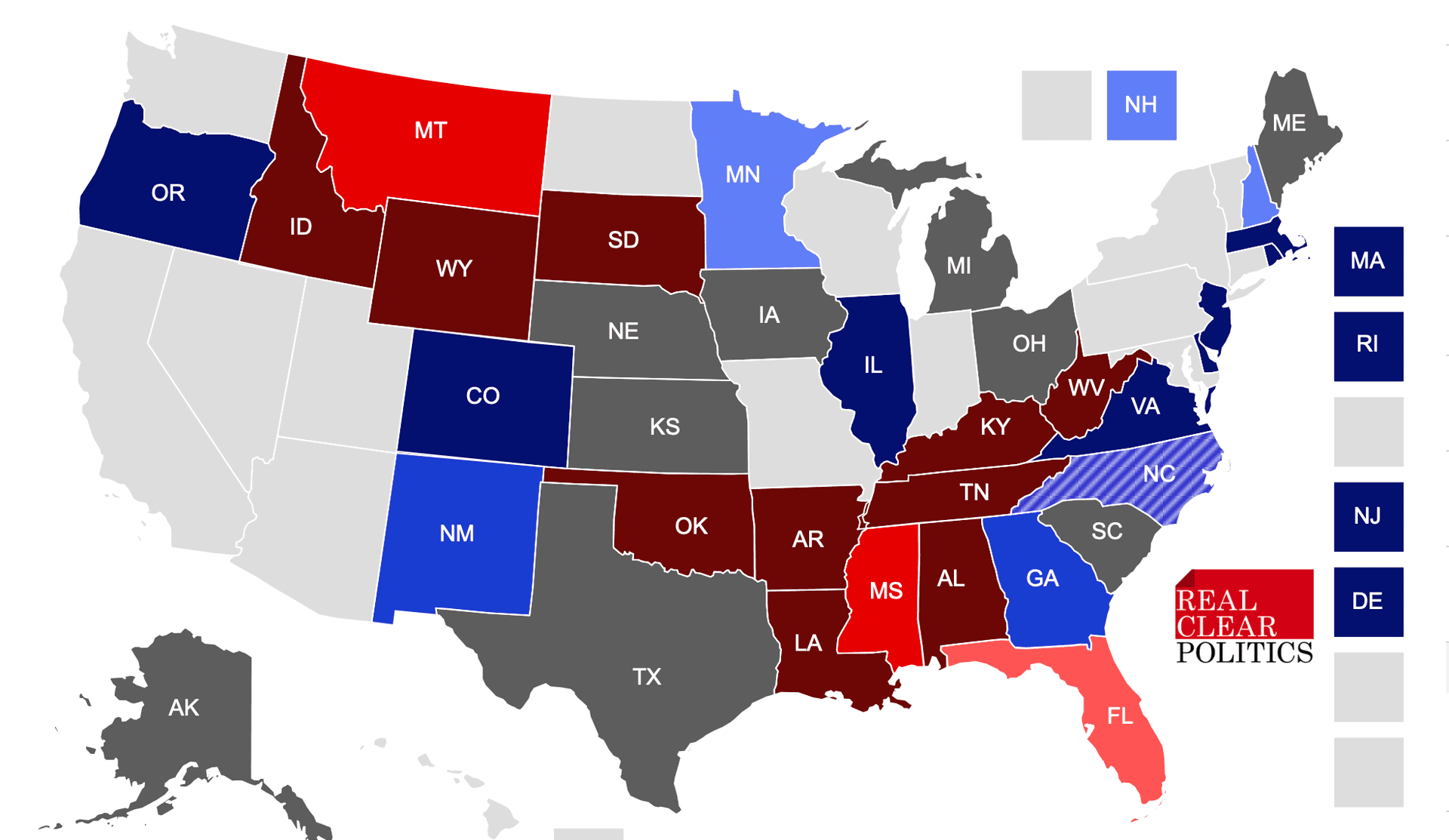
As voters head to the polls, nine Senate races remain toss-ups in the RCP Senate Map, and control of the chamber could come down to just a few of them. If the Senate contest is close, attention will likely focus on a handful of states where races are tight, polls have missed badly in recent elections, or current surveys show widely varying results.
Michigan and South Carolina are less likely to be the tipping points. In Michigan, Democrat Abdul El-Sayed leads Republican Mike Rogers by 4.9 points in the RCP Average, the largest lead in any toss-up race. A Rogers victory would likely signal a strong Republican night, with the party winning enough other close races to retain control. In South Carolina, Republican Darline Graham Nordone leads Democrat Annie Andrews by 2.8 points. An Andrews upset, meanwhile, would likely signal a Democratic wave large enough to deliver a comfortable Senate majority.
If both parties win the states where they hold larger polling leads, control of the Senate will come down to the states in the middle. Five states in particular stand out, either because the race is close to a dead heat, because pollsters have badly missed there in the past, or because the polls disagree enough that the average may not tell the full story.
Iowa
Iowa is the closest race in both the RCP Average and in betting markets, with Republican Ashley Hinson ahead by just 0.5 points in the average while Democrat Josh Turek holds a 52% chance to win on Polymarket
The race has been close all year, and neither candidate has led the RCP Average by more than 2 points at any time. No poll in the current average shows either candidate ahead by more than 2 points, so barring a systemic polling error this cycle, Iowa should be one of the closest races on election night.
Iowa could split from the other toss-ups simply because the race is so evenly matched. Neither candidate has been hurt by scandals or given the other side an easy line of attack, so the outcome may come down to which party turns out slightly better in the state on Election Day, regardless of how the rest of the map breaks.
Alaska and Maine
Democrats Mary Peltola and Troy Jackson lead their RCP Averages in Alaska and Maine by 1 point and 3.3 points, respectively, but both states have a history of significant polling misses that make those leads less certain than they look.
In 2020, the last time Republican Sen. Dan Sullivan was up for reelection in Alaska, the final New York Times poll had him ahead by 8 points, and he went on to win by 12.7. The miss in Maine was even larger. Polls taken in October showed Republican Sen. Susan Collins trailing by 1 to 7 points, but she went on to win by 8.6, meaning the polls underestimated her margin by 9.6 to 15.6 points.
It is unclear whether pollsters have fixed the problems behind those misses this year, overcorrected for them, or are still running into the same issues that threw off their numbers in the past. Because the polling in each state could miss in its own direction, Alaska and Maine may not follow the national trend, and both are worth watching closely if the overall results are tight.
Texas and Kansas
In both Texas and Kansas, Democrats James Talarico and Adam Hamilton hold leads in the RCP Average, but those leads rest heavily on a few favorable polls rather than broad agreement among pollsters.
In Texas, Talarico’s 2.5-point lead over Republican Ken Paxton comes largely from three polls by The New York Times/Siena College, AtlasIntel, and CNN, which had him ahead by 7, 6, and 6 points, respectively. Polls from Trafalgar, Quantus Insights, Rasmussen, and Fox News, on the other hand, had the race tied or showed Paxton up by 1 point.
Similarly, Hamilton’s 3.6-point lead over incumbent Republican Roger Marshall in the Kansas Senate race is driven largely by a Washington Post poll that had Hamilton up 10 points. In the poll’s write-up, the Post said registered Republicans were much harder to reach than registered Democrats and that “there’s good reason to suspect that the poll overestimates Democratic candidates’ support.”
Because pollsters disagree so widely in both races, the polls may not capture where either contest actually stands, which leaves Texas and Kansas open to results that break from the current RCP Averages.
Results
If election night is close and the polls do not systematically underestimate either party, these five states will decide control of the Senate. That assumes Democrats win Ohio and Michigan, where they have their largest leads in both polls and betting markets, and Republicans hold South Carolina and Nebraska, where they have their largest polling leads. Under that scenario, Democrats would need to win two of the five states to take the majority, while Republicans would need to win four to keep it.
State of Union
.