

GOP Gains Ground in Generic Ballot, but Democrats Still Far Ahead
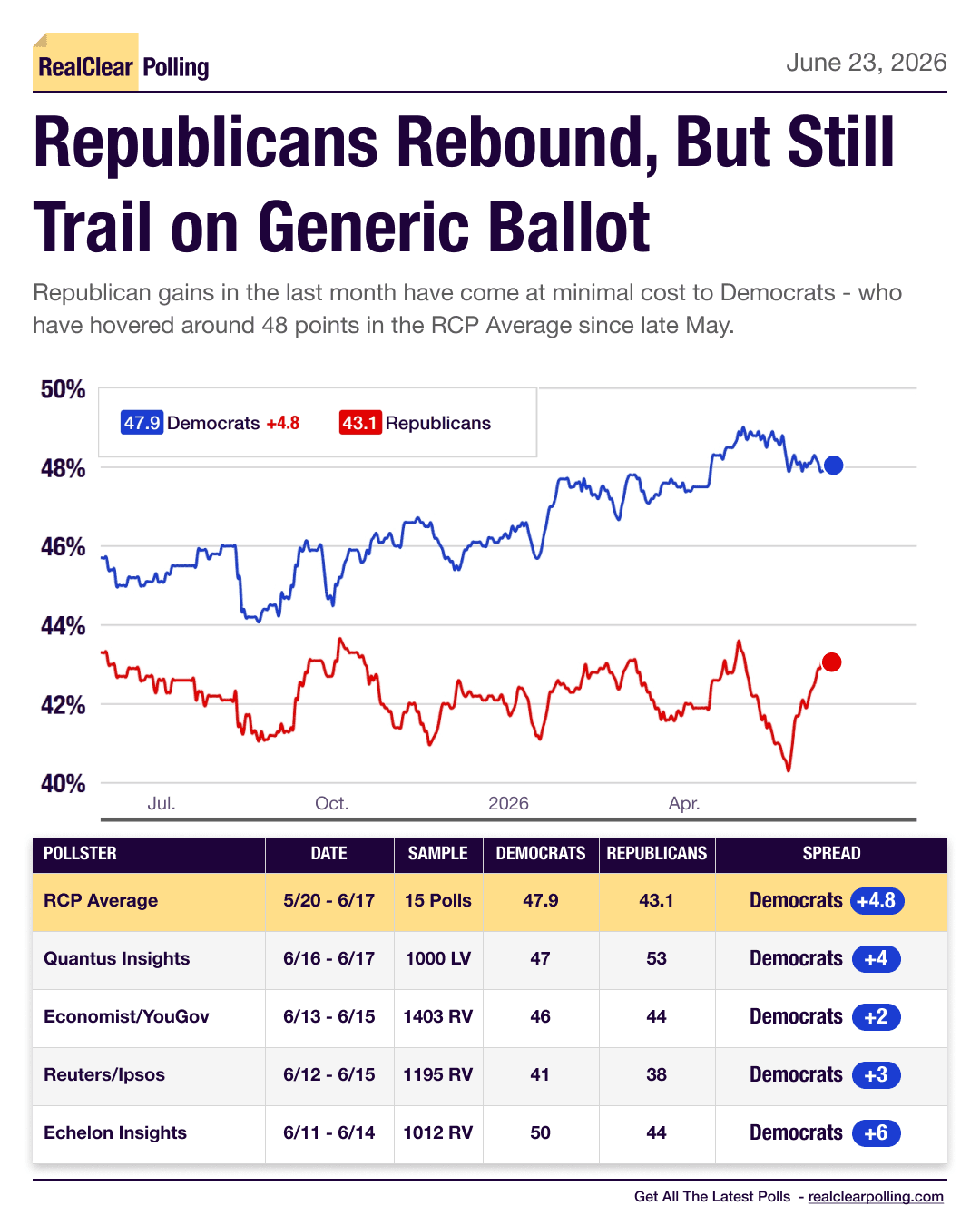
On May 28, Democrats led by 8.1 points in the 2026 Generic Congressional Ballot, a much larger margin than they had held at the same point in recent midterm cycles. Since then, however, Republicans have clawed back a few points. While they still trail, the smaller gap could give them a chance to eke out a narrow win in the midterms.
The shrinkage in Democrats’ lead mostly came from Republicans gaining support. At the end of May, only 40.3% said they would vote for Republicans in November. Now, that number is up to 43.1%, while Democrats still have 47.9% saying they will vote for them, giving them a 4.8-point lead.
Despite Republicans’ expansion in popularity, similar increases in President Trump’s job approval haven’t materialized. Currently, he sits at -16.9 net job approval, up 1.6 points from his -18.5 on May 28.
The war in Iran, which has gone through a series of on-again, off-again ceasefires as they try to negotiate a final peace deal, has only grown increasingly unpopular. In the latest RCP Average, it faces -21.7 net approval, the lowest it has faced since the conflict started.
The rising gas prices as a result of the war have been one of the biggest issues. As the consumer price index rose by 4.2% in the 12 months preceding June 1, the highest level since April 2023, Trump’s net approval on the issue of inflation is the worst of all issues, now at -40.3, with only 28.5% approving. The rising inflation has caused the majority, 57%, to now say the economy is getting worse, while only 16% say it is getting better, according to the latest Economist/YouGov poll.
Even though Republicans are faring slightly better in midterm polling, betting markets don’t think much has changed. In the latest Polymarket betting odds for who will win the House in 2026, they only give Republicans a 20% chance to keep the House, the same 20% they had in late May.
Republicans still have a 20% chance of keeping the House, despite being almost certain to lose the Generic Congressional Vote, because redistricting has netted them approximately 10 additional congressional seats. This, combined with Republicans’ current five-seat majority, means that Democrats need to win approximately 15 seats to gain a majority.
If Democrats maintain their current lead, they are likely to win the required number of seats. In 2024, Republicans won the Generic Congressional Vote by 2.7 points, meaning a 4.8-point Democratic lead would constitute a 7.5-point swing. In 2024, there were 19 seats where a Republican beat a Democrat by 7.5 points or less, meaning Democrats should have enough seats available to win a majority, though specific election dynamics and the chance that Republicans lose by a smaller margin give Republicans a shot at winning.
On the Senate side, Republicans have gained slightly in recent weeks, now leading with a 57% chance to keep control of the Senate, up from 45% in April, according to betting markets. If Republicans are able to hold red states such as Alaska, Iowa, Ohio, and Texas, even if they lose the swing-state Senate seats, they will keep control of the Senate.
State of Union
.